EN
 CN
 RU



IIC Explosion Proof Equipment: When Is IIC Protection Required?
IIC protection is required when a hazardous atmosphere contains Group IIC gases such as hydrogen or acetylene, or when the area classification and equipment certificate specifically require IIC. IIC explosion proof equipment must also match the hazardous-area zone, temperature class, protection method, equipment protection level, ambient limits, and certification conditions. The IIC marking is therefore one part of a complete explosion protection assessment, not a universal approval for every hazardous location.
IIC is the most restrictive IEC 60079 gas group for gases such as hydrogen and acetylene.
IIC-rated equipment may serve many IIB and IIA applications when certificate conditions permit.
Gas group selection does not replace checking zone, temperature class, EPL, or protection technique.
IIB+H2 equipment may satisfy some hydrogen projects, but it is not automatically equivalent to IIC.
North American Class I and Zone markings must be matched with the project’s certification system.
Procurement teams should verify nameplate markings, certificate scope, accessories, ambient limits, and installation conditions.
IIC explosion proof equipment is electrical or electromechanical equipment certified for use in atmospheres containing the most easily ignited gases within the IEC gas group system. The classification is based on ignition characteristics, including the maximum experimental safe gap, minimum ignition current ratio, minimum ignition energy, and the behavior of flame propagation. Common IIC gases include hydrogen and acetylene, although the final classification must be confirmed against the applicable standard, gas data, and project documentation.
IIC is a gas group classification, not a complete explosion-proof approval. A product marked Ex db IIC T4 Gb, for example, communicates several separate conditions: the protection method is flameproof enclosure, the gas group is IIC, the temperature class is T4, and the equipment protection level is Gb. If the installation requires Zone 0 equipment with EPL Ga, that marking may not be sufficient even though it includes IIC.
The IEC 60079 gas group classification divides explosive gas atmospheres according to their ignition and flame-transmission characteristics. IIA represents gases with comparatively lower ignition sensitivity, IIB represents more demanding gases, and IIC represents the most restrictive gas group in ordinary industrial gas classification.
| Gas group | Typical examples | Relative equipment requirement |
|---|---|---|
| IIA | Propane, methane, many petroleum vapors | Equipment certified for IIA, IIB, or IIC may be acceptable when other markings match |
| IIB | Ethylene and similar industrial gases | Equipment should be marked IIB or IIC unless the certificate states otherwise |
| IIC | Hydrogen, acetylene, and similar highly ignitable gases | Equipment normally requires IIC or a specifically accepted equivalent |
An IIC certificate generally provides gas-group coverage for IIB and IIA applications because the equipment has been assessed against more demanding ignition conditions. I cannot treat that hierarchy as permission to ignore the certificate, because enclosure volume, cable entries, accessories, temperature limits, and installation method can restrict the permitted use.
IIC protection is required when the gas or vapor is classified as IIC, when the project specification calls for IIC equipment, or when the certificate and area classification identify IIC as the required gas group. Hydrogen production, hydrogen storage, electrolyzer systems, hydrogen filling stations, acetylene handling, and some battery or chemical processes may create conditions requiring IIC-rated equipment. The requirement still depends on the classified zone and the equipment protection level assigned to that zone.
I use the following decision sequence when reviewing a hazardous-area equipment requirement:
Identify the gas or vapor. Confirm the substance, concentration assumptions, gas group, and temperature data from the hazardous-area dossier or process safety documentation.
Confirm the zone. Determine whether the equipment is installed in Zone 0, Zone 1, or Zone 2, based on the expected frequency and duration of the explosive atmosphere.
Select the required EPL. Zone 0 commonly requires Ga, Zone 1 commonly requires Gb, and Zone 2 commonly requires Gc, subject to the applicable assessment and local rules.
Check the temperature class. Confirm that the equipment’s maximum surface temperature remains below the ignition temperature of the gas under the specified operating conditions.
Match the protection method. Review Ex ia, Ex ib, Ex ic, Ex db, Ex eb, Ex p, Ex n, or another applicable technique.
Verify certification and installation limits. Confirm ATEX, IECEx, North American, or other required approval, together with ambient temperature, ingress protection, cable entry, and accessory conditions.
Hydrogen is commonly treated as an IIC gas because its ignition characteristics create demanding requirements for enclosure joints, electrical energy limitation, and flame transmission control. Acetylene is also generally associated with IIC applications, but the equipment selection must consider the complete marking rather than the gas group alone. For example, a hydrogen installation may require Ex ia IIC T4 Ga instrumentation, while a motor or terminal box in a Zone 1 area may require Ex db IIC T4 Gb.
Zone classification changes the equipment requirement. A sensor installed in Zone 0 may require an intrinsically safe circuit with EPL Ga, while a junction box installed in Zone 1 may use Ex db or Ex eb protection with EPL Gb. Equipment intended for Zone 2 may carry Gc, but a Zone 2 marking does not automatically authorize installation in Zone 1 or Zone 0.
IIC explosion protection works by limiting ignition sources, containing an internal ignition, preventing flame transmission, or maintaining a protective atmosphere around energized components. The selected protection technique determines how the equipment controls electrical arcs, hot surfaces, sparks, internal pressure, and fault energy. A flameproof Ex d enclosure contains an internal explosion, while an intrinsically safe Ex i circuit limits voltage, current, capacitance, and inductance so ignition cannot occur under defined fault conditions.
The gas group is connected to measurable ignition behavior. Maximum experimental safe gap describes the gap dimension under standardized conditions that prevents an internal flame from igniting the external atmosphere. The minimum ignition current ratio compares the current required to ignite a test gas mixture with a reference mixture, while minimum ignition energy describes the smallest spark energy capable of causing ignition. These values help standards committees establish the distinction between IIA, IIB, and IIC.
The gas group does not replace temperature assessment. Hydrogen, acetylene, and other gases can have different ignition temperatures, so a product marked IIC T6 may provide a lower maximum surface temperature than an IIC T4 product. I always check the gas group and temperature class together, because an IIC marking without a suitable temperature class may still be inappropriate.
IIC equipment is assessed for more demanding gas conditions than IIB equipment. In general, IIC-rated equipment can be used in IIB and IIA locations when the certificate, protection method, EPL, temperature class, and installation conditions permit. IIB equipment should not be installed in an IIC atmosphere unless the certification specifically identifies the required gas coverage.
IIB+H2 equipment is a special marking used in some certification systems to indicate suitability for IIB gases plus hydrogen under defined test conditions. It should not be treated as automatically identical to IIC equipment, because the certificate may define different construction, test, or application conditions. A project specification may accept IIB+H2 for hydrogen service, while another project may explicitly require IIC due to owner standards, authority requirements, or the selected protection technique.
| Selection factor | IIC equipment | IIB+H2 equipment |
|---|---|---|
| Gas-group scope | Generally covers IIC and lower groups when certified | Covers IIB gases and hydrogen under stated conditions |
| Typical use | Hydrogen, acetylene, and projects specifying IIC | Selected hydrogen and IIB applications |
| Procurement risk | Usually broader gas-group coverage | Certificate wording must be examined carefully |
| Automatic interchangeability | No; markings and certificate scope still apply | No; it is not a universal substitute for IIC |
When a specification allows either option, I compare the certificate scope, temperature class, EPL, protection technique, ambient range, cable entries, and approved accessories. The lower purchase price of one enclosure does not establish technical equivalence if the approved installation conditions differ.
IEC gas groups and North American hazardous-location markings describe related risks through different classification systems. In North America, hydrogen is commonly associated with Class I, Division 1, Group B, while acetylene is also associated with Group B. However, Class I Division 1 and Division 2 describe the likelihood of a hazardous atmosphere, whereas IIA, IIB, and IIC describe gas characteristics.
Zone 0, Zone 1, and Zone 2 classifications are not interchangeable with Division 1 and Division 2 without reviewing the applicable code, certificate, and installation method. For example, a product carrying an IECEx Ex db IIC Gb marking may not be directly accepted in a Class I Division 1 installation unless it also has the required North American approval or is accepted under the project’s conformity process.
I treat these as separate checks: gas group, area classification, product certification, wiring method, and authority approval. This prevents a common purchasing error in which an installer sees “IIC” on a nameplate and assumes that the equipment is automatically approved for every Class I or Zone location.
Before approving IIC-rated equipment, I review the product nameplate and certificate rather than relying on a catalog title. The nameplate should identify the complete Ex marking, certificate number, ambient range, electrical ratings, temperature class, and any special conditions of use. The certificate should define the tested configuration and any limitations on cable glands, stopping plugs, mounting orientation, enclosure accessories, or field wiring.
Use this procurement checklist:
Gas group: Confirm IIC, IIB+H2, IIB, or another specified classification.
Zone and EPL: Match Zone 0, Zone 1, or Zone 2 with Ga, Gb, or Gc as required.
Temperature class: Check T1 through T6 against the gas ignition temperature and process conditions.
Protection technique: Confirm Ex ia, Ex ib, Ex ic, Ex db, Ex eb, Ex p, or the specified method.
Certification: Verify IECEx, ATEX, UL, CSA, or other approval required by the project.
Ambient limits: Check the certified operating range, enclosure temperature, and derating requirements.
Ingress protection: Confirm the IP rating for water, dust, washdown, and outdoor exposure.
Accessories: Use only cable glands, plugs, reducers, adapters, and seals within the certificate scope.
Electrical ratings: Verify voltage, current, short-circuit rating, and maximum permitted load.
Maintenance conditions: Confirm inspection intervals, fastener requirements, and repair restrictions.
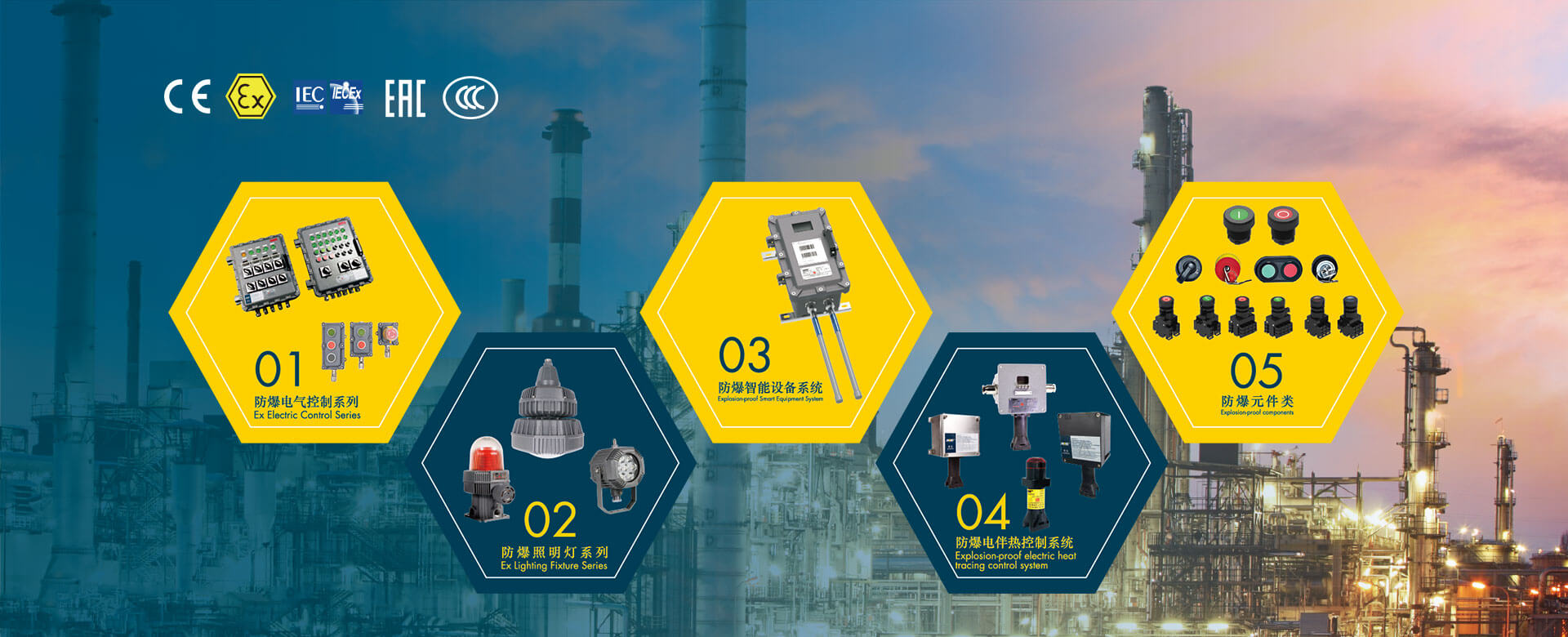
MAM provides ex electrical equipment such as explosion-proof control panels, junction boxes, lighting systems, cable glands, enclosures, distribution systems, and hazardous-area automation equipment. Its product listings include IIC explosion-proof terminal boxes and IIB+H2 terminal boxes, which makes certificate comparison particularly important when reviewing hydrogen or mixed-gas applications. MAM states that its business supports industries including oil and gas, petrochemical processing, offshore facilities, pharmaceutical production, and chemical processing, with ATEX and IECEx certification options presented for relevant equipment categories.
Consider a hydrogen compressor building classified as Zone 1. A terminal box in that area may require Ex db IIC T4 Gb, but the correct choice also depends on the enclosure’s certified ambient range, cable entry system, and short-circuit rating. Selecting an IIC product with EPL Gc would not satisfy a Zone 1 requirement merely because the gas group is correct.
In a solvent-processing plant using an IIB gas, IIC equipment may be technically suitable if the temperature class and EPL match the area. However, an IIC enclosure with a non-certified cable gland can invalidate the installation because the assembly no longer follows the tested protection arrangement.
For a Zone 2 hydrogen application, a project may specify Ex ec IIC T4 Gc or another permitted technique. The equipment must still be suitable for the actual electrical load, outdoor conditions, IP rating, and inspection requirements. These examples show why the gas group alone does not guarantee equipment suitability.
IIC Explosion Proof Equipment: When Is IIC Protection Required? IIC-rated equipment is required when the hazardous gas is classified as IIC, particularly for hydrogen or acetylene, or when the project certificate and area classification specify IIC protection. IIC equipment may cover many IIB and IIA applications, but only when the complete marking and certificate conditions allow that use.
My recommended selection process is to identify the gas group first, then confirm Zone 0, Zone 1, or Zone 2, EPL, temperature class, protection method, certification system, ambient limits, and approved accessories. For hydrogen projects, I compare IIC with IIB+H2 instead of assuming that both markings have identical scope. Before purchase, I verify the nameplate, certificate number, special conditions of use, cable entries, and installation drawings so the selected ex electrical equipment is suitable as a complete certified assembly.